Project Overview
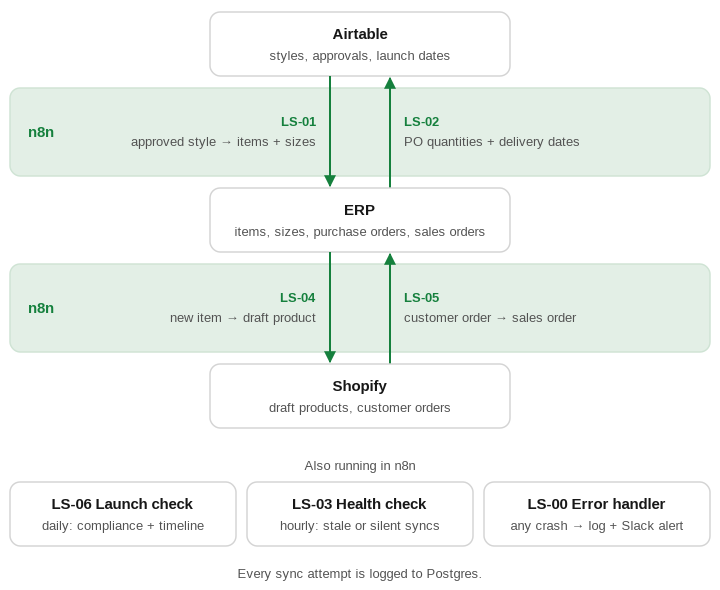
Launch Sync is a working proof of concept for a direct-to-consumer apparel brand: seven n8n workflows that connect Airtable, the ERP and Shopify. ERPNext stands in for NetSuite and Postgres for Snowflake. The brand, Demo Apparel Co., is fictional, all data is simulated, and everything runs on free tiers or self-hosted Docker.
For the wider picture, the interactive systems map covers all nine data flows in a typical Shopify + NetSuite brand: what breaks, what to check, and who owns which data.
The Problem It Solves
Every new product has to exist in three systems that don't talk to each other. Production designs styles in Airtable, Finance and Inventory buy against them in the ERP, and customers buy them on Shopify. Without an integration, people copy data between them by hand:
- Every approved style is re-keyed into the ERP before Finance can raise a purchase order.
- PO quantities and delivery dates are copied back to Airtable so Production can see them without logging into the ERP.
- Nobody knows when a handoff fails. A typo or a skipped step only surfaces later, downstream.
Launch Sync replaces those handoffs with the workflows above.
Design Decisions
Webhook plus a safety-net poll. Every inbound flow is event-driven, but each one also runs on a schedule that picks up anything the webhook missed. Webhooks get dropped. The poll is what makes the sync trustworthy.
Idempotent upserts. ERP items are matched on the Airtable record ID, not created blindly, so a retried or duplicated event updates the existing item instead of creating a second one. Shopify orders are keyed on the order ID for the same reason.
The record is the source of truth, not the payload. A webhook only says which record changed. The workflow re-reads that record before acting, so a stale payload can't push bad data into the ERP.
Errors say how to fix the data. A validation failure writes Sync Status = Error and a plain-language message back to the Airtable row, so the person who owns the data can fix it without opening n8n.
Transient vs. permanent failures. Rate limits, 5xx responses, and network errors are retried. Bad data is not. Each failure is categorized before it's handled.
Everything is audited. Every sync attempt, success or failure, lands in audit.sync_audit_logs. dbt models and nine analytics queries sit on top of it, and a drift-reconciliation script reports anything that exists in one system but not the other.
Testing, Docs & Tech Stack
- 149 JavaScript tests covering SKU rules, the compliance gate, error categorization, Shopify HMAC verification, and a check that the committed workflow JSON matches its source.
- 42 Python tests covering ERPNext bootstrap, the Airtable schema-as-code, the PO simulator, and drift reconciliation.
- dbt tests on the audit models.
- n8n workflows are generated from version-controlled source, not hand-edited in the UI, so the logic that's tested is the logic that runs.
Tests run in GitHub Actions on every push.
The repo ships with:
- SETUP: build the stack from scratch, one checked step at a time.
- ARCHITECTURE: diagrams, field mappings, and design decisions.
- RUNBOOK: operations, failure modes, and incident response.
Tech stack: n8n (self-hosted), Airtable, ERPNext, Shopify Admin API, Postgres, dbt, Python, JavaScript, Docker Compose, Slack